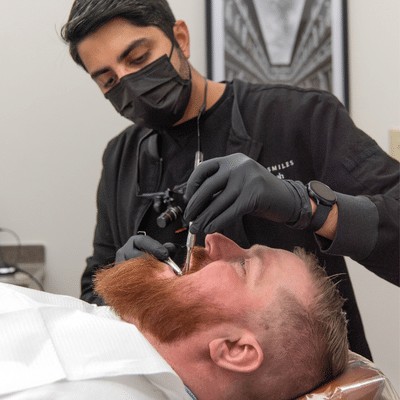
Your Guide to Full Arch Dental Implants in Cary, NC
Quick Answer
Full arch dental implants use several implants in the jaw to support a complete row of replacement teeth. All-on-X is an approach to this treatment, with “X” referring to the number of implants used. It may help adults missing most or all teeth in one jaw, but choosing it requires an examination of your remaining teeth, bone, gums and overall health.
Key Takeaways
One arch means the upper or lower row of teeth; treating both requires separate planning.
All-on-X supports a connected set of teeth without placing an implant for every tooth.
Fixed replacement teeth stay in your mouth, while removable implant dentures come out for cleaning.
Temporary teeth on surgery day may be possible, but healing still takes time.
Daily cleaning, follow-up visits and future maintenance remain essential.
Full Arch Dental Implants Replace an Entire Row of Teeth
At Cary Smiles in Cary, NC, full arch dental implants replace all teeth in an upper or lower arch using a restoration supported by implants. The implants sit in the jawbone, and connectors attach the replacement teeth above them.
This approach differs from replacing one missing tooth with an individual implant and crown. A full arch restoration connects multiple teeth into a single appliance supported at several points.
“Full arch” also differs from “full mouth.” You may need treatment only in your lower jaw while keeping your upper natural teeth. An evaluation should address each jaw separately rather than assume both need the same treatment.
The American Academy of Periodontology explains that implant-supported full mouth restorations can provide greater stability than conventional dentures and help preserve supporting jawbone. Results depend on your anatomy and treatment plan.
What Does All-on-X Mean?
All-on-X is an approach to full arch dental implants in which a planned number of implants supports a complete row of replacement teeth. The “X” stands for that number.
You may also hear about All-on-4, a specific approach using four implants in one jaw. Other plans may use a different number. Choosing the number is a clinical decision, not simply a choice between packages.
Ask why a particular arrangement is recommended for your mouth. The explanation should connect the plan to your bone, bite and restoration design.
A consultation about full arch dental implants may be helpful if missing teeth or widespread dental problems are affecting your daily life.
Reasons to ask about your options include:
Missing most or all teeth in one jaw.
A denture that shifts when you speak or eat.
Avoiding foods because chewing is difficult.
Several damaged teeth and uncertainty about their long-term outlook.
Feeling uncomfortable smiling because of tooth loss.
These concerns don’t automatically mean you need implants or extractions. If you still have natural teeth, ask which can be predictably preserved. Full arch treatment should follow an assessment of those teeth, not replace it.
Adults with extensive tooth loss may be candidates for full arch dental implants if their mouth and health can support implant surgery and healing.
Dr. Rahee Shah will assess bone support, gum health, medical conditions and medications. Insufficient bone may require grafting or a different treatment plan. Smoking interferes with healing and reduces implant success.
Be ready to discuss diabetes, prior gum disease, tobacco use and medications that affect bone health. These details help guide a safe plan; having a medical condition doesn’t automatically rule treatment out.
Your ability to clean beneath the replacement teeth matters, too. If arthritis or another condition makes cleaning difficult, explain that during your consultation so the design and home-care plan can account for it.
A Care Perspective From Cary Smiles
Cary Smiles emphasizes lasting relationships, patient education and care in a calming setting. For someone considering full arch treatment, that approach means having room to discuss everyday concerns: eating comfortably, understanding the process and knowing how ongoing care will work.
With Dr. Shah as the practice’s dentist, the focus is on a plan built around the person receiving care. A consultation is an opportunity to ask questions and understand your choices before deciding.
How Do Implants Compare With Dentures?
The main difference is how the replacement teeth are supported and whether you remove them yourself.
Option
How It Works
Main Considerations
Conventional full denture
Rests on the gums and is removed by the patient.
Avoids implant surgery; fit and stability can change.
Removable implant overdenture
Attaches to implants and comes out for cleaning.
Adds retention; requires surgery and attachment maintenance.
Fixed full arch restoration
Attaches to implants and is removed by a dental professional when needed.
Stays in place for daily use; requires careful cleaning underneath.
Implant-supported dentures can be fixed or removable. “Implant teeth” alone doesn’t tell you which design you’re getting, so confirm this before proceeding.
Also ask how each option would address your priorities. Someone most concerned about stability may make a different choice from someone who values easy removal for cleaning.
What Happens During the Evaluation?
An evaluation for full arch dental implants typically includes a dental examination, medical history review and imaging to assess the jaw.
X-rays and, when indicated, three-dimensional imaging help evaluate bone and nearby structures. Dr. Shah also considers remaining teeth, your bite and the proposed restoration. Some cases require collaboration with an oral surgeon, periodontist or other specialist.
Bring a medication list and describe what is hardest about your current teeth or dentures. Specific examples are useful: “My lower denture lifts when I talk” gives Dr. Shah more direction than “I want better teeth.”
Ask:
Which natural teeth can be saved?
Why is this implant arrangement recommended?
Who will perform each part of treatment?
What teeth will I wear while healing?
What happens if the original plan needs to change?
What Are the Main Treatment Steps?
Treatment with full arch dental implants moves from planning through surgery, healing and placement of the final teeth. Your sequence may differ depending on preparatory care and implant stability.
Create the plan. Review findings, alternatives, costs and the proposed replacement teeth.
Prepare the mouth. Complete necessary treatment, which may include extractions or grafting.
Place the implants. Surgery creates the foundation for the restoration.
Allow healing and monitor progress. Bone joins with the implant surface through a process called osseointegration.
Fit the final restoration and continue care. Review fit, bite, appearance and cleaning.
Healing can take several months, and some steps may be combined while others require separate appointments.
Ask for a written timeline with milestones rather than one promised completion date.
Can You Get New Teeth the Same Day?
Some patients receive temporary teeth around the time of implant placement, but that doesn’t mean treatment or healing is complete.
Whether immediate attachment is appropriate depends on the implants’ initial stability and other clinical factors. Our team should explain both the expected approach and the backup plan if fixed temporary teeth cannot be attached safely.
Before scheduling, ask whether “same-day teeth” means temporary or final teeth, what eating restrictions apply and when the final restoration will be made.
What Are the Benefits and Risks?
Full arch implant treatment offers a more stable replacement for missing teeth, but it involves surgery and long-term care.
Potential benefits include improved chewing, a natural-looking smile and greater confidence with replacement teeth. Implants also provide support within the jaw rather than relying only on the gums.
Possible complications include infection, failure of an implant to integrate, nerve injury and damage involving nearby structures. The restoration or connecting components may also need repair. Discuss these risks and how they would be managed before treatment.
If you’re postponing care, an evaluation can still help clarify your choices. It doesn’t commit you to surgery. The immediate goal may be treating discomfort, improving a denture or protecting remaining teeth.
How Do You Care for Your New Teeth?
Caring for full arch dental implants and a fixed restoration means cleaning the replacement teeth and the tissues beneath them every day.
Our team should demonstrate how to reach beneath the arch and recommend suitable tools, which may include threaders, interdental brushes or a water flosser. Ask to practice the technique before leaving.
Implants don’t develop cavities, but the surrounding tissues can develop inflammation. Peri-implantitis involves loss of supporting bone, making regular monitoring important.
Helpful habits:
Follow your prescribed cleaning and recovery instructions.
Keep maintenance appointments.
Report bleeding, discomfort or changes in your bite.
Avoid:
Assuming artificial teeth require no cleaning.
Trying to tighten or repair the restoration yourself.
Resuming unrestricted eating before our team clears you.
If missing teeth or an unstable denture is making meals and conversations harder, request an appointment with Cary Smiles. Dr. Shah evaluates your dental concerns and discusses whether full arch dental implants or another approach may suit your needs.
Bring your questions about comfort, cost and long-term care. You can also bring a trusted family member to help take notes and discuss practical details.
Rahee Shah, DMD, provides family and cosmetic dental care at Cary Smiles. Dr. Shah earned an undergraduate degree at Rutgers University and a Doctor of Dental Medicine degree at Tufts University School of Dental Medicine. Additional education includes a residency at Robert Wood Johnson Hospital and an implant course at New York University.
Before moving to North Carolina, Dr. Shah spent six years practicing general dentistry in New Jersey, providing care that included endodontics and implants. At Cary Smiles, our practice emphasizes a welcoming environment, modern dental technology and meaningful relationships with patients. Outside the office, Dr. Shah enjoys exploring local restaurants, traveling and connecting with the community.
Frequently Asked Questions
Is All-on-X the same as All-on-4?
All-on-4 is a specific four-implant approach, while All-on-X uses “X” to describe the planned number of implants supporting one arch. The terms describe related concepts, but they shouldn’t replace a clear explanation of your individual plan. Ask how many implants are proposed, where they will go and what kind of restoration will attach to them. Also confirm whether it is fixed or removable. Comparing these details is more useful than comparing treatment names alone.
Do full arch dental implants replace both upper and lower teeth?
Full arch dental implants replace one complete row of teeth; treating both rows requires a plan for each jaw. If only your lower teeth need replacement, your upper natural teeth may remain. Ask Dr. Shah to explain the recommendation separately for each arch, including the outlook for existing teeth. When reviewing an estimate, confirm whether it covers one jaw or both. This helps prevent confusion when comparing treatment proposals that use terms such as “full arch,” “full mouth” or “complete smile.”
Can my existing denture attach to implants?
An existing denture can sometimes be modified for implant attachment, but its condition and design must be evaluated first. A denture that works reasonably well on the gums may not be appropriate for the planned implant system. Bring it to your consultation and ask whether modification is practical or whether a new appliance is recommended. Also clarify whether the proposed result would remain removable. Adding implants beneath a denture doesn’t automatically convert it into a fixed All-on-X restoration.
How much do full arch dental implants cost?
The cost depends on your treatment needs, the restoration and the procedures included, so an examination is needed for an individualized estimate. Ask for a written breakdown covering implants, temporary and final teeth, extractions, grafting, anesthesia and follow-up care where applicable. Ask separately about maintenance and future repairs. Insurance benefits vary, and an estimate of coverage is not a guarantee of payment. When comparing proposals, make sure each includes the same stages rather than judging only the advertised starting price.
Are full arch dental implants permanent?
Fixed full arch teeth stay in your mouth during normal use, but “permanent” doesn’t mean they never need maintenance or replacement. Dr. Shah can remove a fixed restoration when necessary. Ask about the expected maintenance for the materials and components in your plan, including what happens if a tooth chips or an attachment loosens. Keep copies of your treatment records and implant information. Understanding future care is part of making an informed decision today.
Full arch dental implants can offer a stable way to replace a complete row of teeth. The right choice starts with understanding your existing dental health, available alternatives and the care your new teeth will need.
Take the Next Step Toward a More Comfortable Smile
If missing teeth or an unstable denture is affecting how you eat, speak or smile, full arch dental implants may be worth exploring. At Cary Smiles in Cary, NC, Dr. Rahee Shah can evaluate your oral health, explain your options and help you make an informed decision in a comfortable, welcoming setting. Learn more about All-on-X dental implants or call or text 919-233-3545 to request your appointment.
This article is for general educational purposes and is not a substitute for personalized medical or dental advice. Diagnosis and treatment recommendations should come from an appropriately qualified healthcare professional.